

Table of Contents
Navigating the taxes buying apartment Athens Greece requires a clear understanding of upfront acquisition costs, annual property levies, and income tax obligations. For foreign investors, the Greek tax system can initially seem complex, but it is highly structured and currently offers significant incentives, such as the suspension of capital gains tax and VAT on new builds. As Greece’s premier buyer’s agent in Greece, our team at Atalos Estate specializes in guiding international clients—from the US, UK, and beyond—through every financial and legal nuance of the purchasing process. Whether you are acquiring a pied-à-terre in Kolonaki or a high-yield investment property, understanding your tax liabilities is the first step toward a secure and profitable transaction.

💡 Key Takeaways
- Upfront Transfer Tax: The standard property transfer tax in Athens is a flat 3.09% of the property’s value, making acquisition costs highly competitive compared to other European capitals.
- VAT Suspension: The 24% Value Added Tax (VAT) on newly constructed properties has been suspended, offering massive savings for buyers of modern developments.
- Annual Property Tax: The ENFIA (Uniform Real Estate Property Tax) is an annual levy calculated based on property size, location, and age, typically ranging from €3 to €10 per square meter.
- Capital Gains Exemption: Greece has suspended the 15% capital gains tax on real estate sales until at least December 31, 2026, maximizing exit profitability for investors.
What Are the Upfront Taxes Buying an Apartment in Athens, Greece?
The primary upfront tax when buying an apartment in Athens is the Property Transfer Tax (FMA), which is calculated at a flat rate of 3.09%. This tax is paid by the buyer prior to the signing of the final contract and is a mandatory step for the notary to proceed with the transaction.
When evaluating apartments for sale in Athens, foreign buyers must account for this transfer tax as part of their closing costs. Historically, Greece imposed a 24% VAT on newly built properties (permits issued after 2006). However, the Greek government has suspended this VAT requirement to stimulate foreign investment and construction. This suspension means that whether you are buying a historic neoclassical apartment in Plaka or a brand-new, off-plan development, you will only pay the 3.09% transfer tax.
This unified tax structure drastically reduces the barrier to entry for international buyers. It is important to note that the 3.09% is calculated on either the “objective value” (the tax value assessed by the state) or the actual purchase price—whichever is higher. In highly sought-after areas, the market price usually exceeds the objective value, meaning the tax is based on your final agreed purchase price.
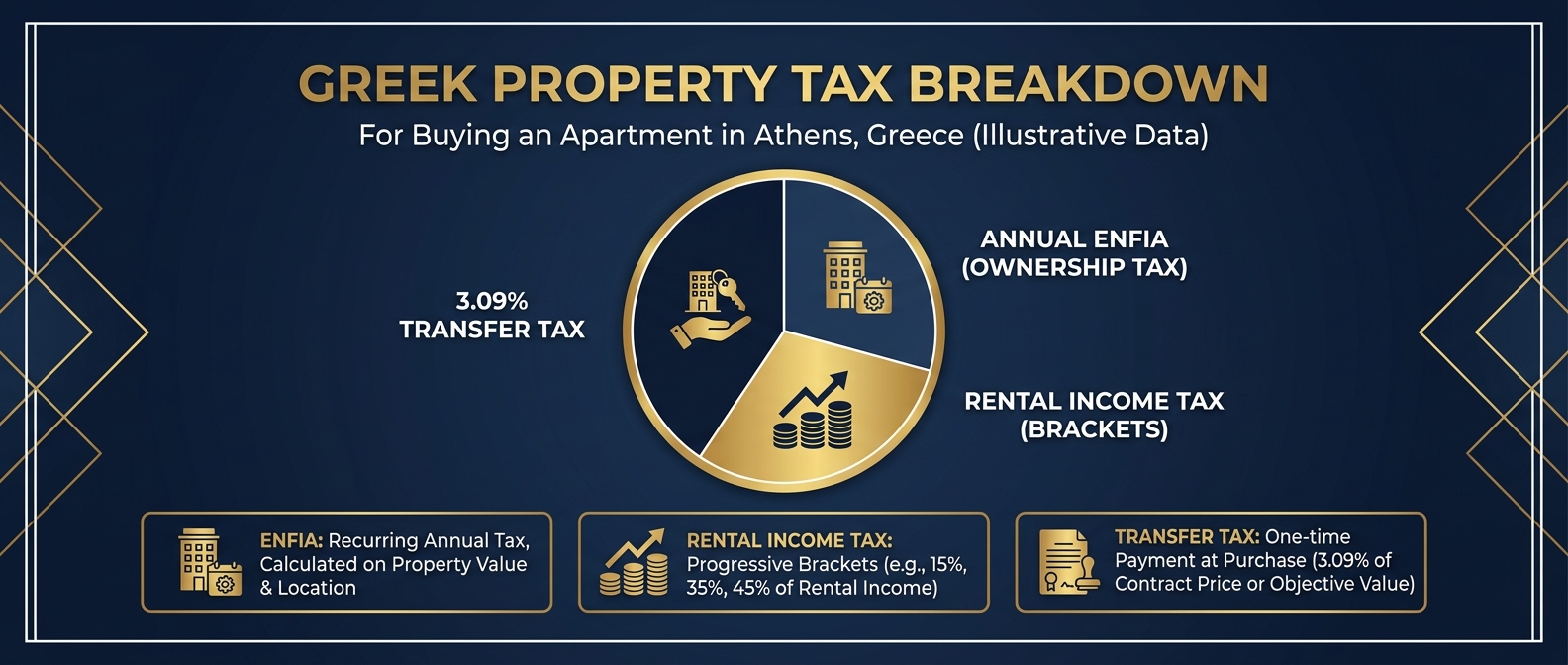
Greek Property Tax Comparison Table
To provide a clear overview of your financial obligations, we have compiled a breakdown of the primary taxes associated with acquiring, holding, and profiting from Greek real estate.
| Tax Type | Current Rate | When It Is Paid | Who Pays |
|---|---|---|---|
| Property Transfer Tax (FMA) | 3.09% | Once, before contract signing | Buyer |
| VAT on New Builds | 0% (Suspended) | N/A (Normally 24%) | Buyer |
| Annual Property Tax (ENFIA) | Varies (€3 – €10/sqm) | Annually (can be paid in installments) | Owner |
| Rental Income Tax | 15% – 45% | Annually (based on generated income) | Owner |
| Capital Gains Tax | 0% (Suspended) | N/A (Normally 15% on profit) | Seller |
How Is the Property Transfer Tax Athens Calculated?
The property transfer tax Athens is calculated by taking 3.09% of the highest value between the property’s state-assessed objective value and the actual commercial purchase price. The buyer’s legal representative must submit the tax declaration to the Greek Independent Authority for Public Revenue (AADE) and pay the amount in full before the notary can draft the final deed.
For foreign investors, understanding the distinction between objective and commercial value is crucial. The Greek Ministry of Finance assigns an “objective value” to every property based on its zone, size, floor level, and age. In the past, objective values were significantly lower than market prices. Recent government updates have aligned these values more closely with market realities, particularly in premium neighborhoods. If you are purchasing luxury Athens Riviera apartments, the market price will almost certainly dictate your tax basis.
In addition to the 3.09% transfer tax, buyers should budget approximately 3% to 4% for other closing costs, which include notary fees, land registry fees, and legal representation. At Atalos Estate, we ensure our clients receive a comprehensive breakdown of all closing costs before making an offer, ensuring there are no hidden financial surprises.
🚀 Expert Insight
In our experience at Atalos Estate, many foreign buyers are surprised to learn that the 3.09% transfer tax includes a 3% base rate plus a 3% municipal surcharge on that base rate (effectively 3.09%). Always ensure your funds for this tax are transferred to your Greek bank account well in advance, as the Greek tax authority requires cleared funds before issuing the tax clearance certificate necessary for closing.
How Does the Annual Property Tax (ENFIA Athens) Work?
The ENFIA Athens (Uniform Real Estate Property Tax) is an annual tax levied on all property owners in Greece, calculated using a complex formula that factors in the property’s location, size, floor, age, and facade. For a standard apartment in Athens, foreign owners can expect to pay between €3 and €10 per square meter annually.
ENFIA is mandatory for all property owners, regardless of their tax residency status or nationality. The tax is assessed every year on January 1st, and the Greek tax authority issues the ENFIA bills typically between April and August. Owners have the option to pay the total amount upfront or in up to ten equal monthly installments, making it highly manageable.
If you are investing in Greece golden visa properties, ENFIA will be your primary ongoing holding cost. The exact amount varies significantly by neighborhood. For instance, an apartment in the exclusive Kolonaki district or the coastal suburb of Glyfada will carry a higher ENFIA burden than a similarly sized apartment in Kypseli or Pagrati, due to the higher objective zone values assigned to premium areas.

What Are the Taxes on Rental Income for Foreign Investors?
Rental income earned from Greek property is taxed on a progressive scale starting at 15% for the first €12,000 of annual income. This tax applies to all rental revenue generated within Greece, regardless of whether the owner is a Greek tax resident or a foreign investor living abroad.
For international buyers purchasing property for yield, understanding these brackets is essential for calculating net ROI. The current Greek rental income tax brackets are structured as follows:
- 15% on income up to €12,000
- 25% on income between €12,001 and €24,000
- 35% on income between €24,001 and €35,000
- 45% on income exceeding €35,000
In addition to the standard rental tax, a “solidarity contribution” may apply to higher income brackets, though recent legislative changes have frequently adjusted or suspended this for private sector incomes. It is also important to note that a flat 5% deduction is automatically applied to your gross rental income to account for maintenance and depreciation before the tax is calculated.
Whether you are renting out a long-term residential unit or operating a short-term Airbnb, these rates apply. For investors looking at larger commercial yields, such as Greek hotels for sale, corporate tax structures (currently at 22%) may be more beneficial than holding the property as a private individual.
🚀 Expert Insight
Our team at Atalos Estate frequently advises clients on the “€12,000 threshold.” If you are buying a property specifically for short-term holiday rentals, keeping your gross annual income just under €12,000 ensures you remain in the highly favorable 15% tax bracket. For higher-yielding luxury properties, we recommend consulting with our partnered Greek tax accountants to explore corporate ownership structures.
Is Capital Gains Tax Applicable to Greek Real Estate?
Currently, there is no capital gains tax on the sale of real estate in Greece, as the government has suspended the standard 15% rate until at least December 31, 2026. This suspension allows foreign investors to sell their Greek properties and retain 100% of the profit generated from property appreciation.
This tax holiday has been a massive catalyst for the Greek real estate market, particularly for buyers from the US and UK looking for high-growth European assets. Historically, Greece imposed a 15% tax on the difference between the purchase price and the sale price. The ongoing suspension of this tax is part of a broader government initiative to maintain liquidity and attractiveness in the property sector.
If you are purchasing houses for sale in Greece with a medium-term exit strategy, this zero-tax environment on capital gains provides a distinct advantage over other Mediterranean markets like Spain or Italy, where capital gains taxes can significantly eat into your investment returns.
If you are ready to explore tax-efficient investment opportunities in the Greek capital, Submit a Property Request today, and our expert buyers’ agents will curate a portfolio tailored to your financial goals.
How Do Double Taxation Treaties Protect Foreign Buyers?
Double taxation treaties ensure that foreign buyers do not pay tax twice on the same Greek rental income in both Greece and their home country. Greece has robust double taxation agreements (DTAs) with over 50 countries, including the United States, the United Kingdom, Canada, and most EU member states.
When you earn rental income in Athens, you are required to pay the applicable Greek income tax (starting at 15%). However, because of these treaties, you can typically claim a foreign tax credit on your home country’s tax return for the taxes paid in Greece. For example, a US citizen earning rental income from an apartment in Athens will declare that income to the IRS but will use the taxes paid to the Greek AADE to offset their US tax liability.
To benefit from these treaties, foreign buyers must obtain a Greek Tax Registration Number (AFM) and appoint a local tax representative. This representative does not assume your tax liability but acts as a liaison between you and the Greek tax authorities, ensuring your annual declarations are filed correctly and on time. Whether you are buying in the capital or looking at Corfu properties for sale, setting up this tax infrastructure is a mandatory and straightforward process that Atalos Estate handles for all our clients.
🚀 Expert Insight
We always remind our US and UK clients that while the Double Taxation Treaty protects you from paying twice, it does not exempt you from reporting. You must file an E2 (rental income) and E1 (general income) form in Greece annually, even if your income is zero, to maintain compliance and protect your Golden Visa status.

To ensure your property acquisition is structured for maximum tax efficiency, Contact Our Team at Atalos Estate. We provide end-to-end representation, connecting you with top-tier legal and tax professionals to secure your investment.
⚠️ Important Note for Golden Visa Investors: The short-term rental (Airbnb) strategies discussed in this article apply to standard investment properties. Properties purchased under the Greek Golden Visa scheme are prohibited from short-term rental under Law 5100/2024 and must be leased on a long-term basis (12+ months). If your goal is residency through investment, focus on the strong, stable long-term rental yields outlined above.
FAQ — Frequently Asked Questions
How much is the property transfer tax in Athens?
The property transfer tax in Athens is a flat rate of 3.09% of the property’s value. This is calculated based on either the state-assessed objective value or the actual purchase price, whichever is higher. The buyer must pay this tax in full before the final contract can be signed before a notary.
Do foreign buyers pay ENFIA in Athens?
Yes, all property owners in Greece, including foreign non-residents, must pay the annual ENFIA tax. The amount is calculated based on the property’s size, location, age, and floor level. For most apartments in Athens, this annual tax ranges between €3 and €10 per square meter.
Is there VAT on new apartments in Greece?
Currently, there is no VAT on new apartments in Greece. The government has suspended the standard 24% VAT on newly constructed properties until at least the end of 2026. Buyers of new developments only pay the standard 3.09% property transfer tax, resulting in significant savings.
How is rental income taxed for non-residents in Greece?
Non-residents are taxed on Greek rental income at the same progressive rates as locals. The tax rate is 15% for annual rental income up to €12,000, 25% for income between €12,001 and €24,000, 35% for income between €24,001 and €35,000, and 45% for income exceeding €35,000. Double taxation treaties usually allow you to credit this tax against your home country’s tax liabilities.
Do I need a Greek tax number to buy property?
Yes, obtaining a Greek Tax Registration Number (AFM) is a mandatory legal requirement for buying property in Greece. You will also need to open a Greek bank account and appoint a local tax representative if you are a non-EU resident. A buyer’s agency like Atalos Estate facilitates this entire setup process on your behalf.