

Navigating the Greek real estate market offers incredible opportunities, but the most common Greece property buying mistakes foreigners make can turn a dream investment into a costly legal nightmare. Whether you are seeking a lucrative investment, securing a Golden Visa, or purchasing a sun-drenched holiday home, the Greek property acquisition process is quite complex, bureaucratic, and heavily weighted in favour of the seller. Our team at Atalos Estate, Greece’s premier buyer-only agency, has witnessed countless international investors lose thousands of euros by skipping crucial due diligence, trusting the wrong advisors, or misunderstanding local zoning laws. To protect your capital and ensure a seamless transaction, you must know exactly what to avoid in the Greek property market.

💡 Key Takeaways
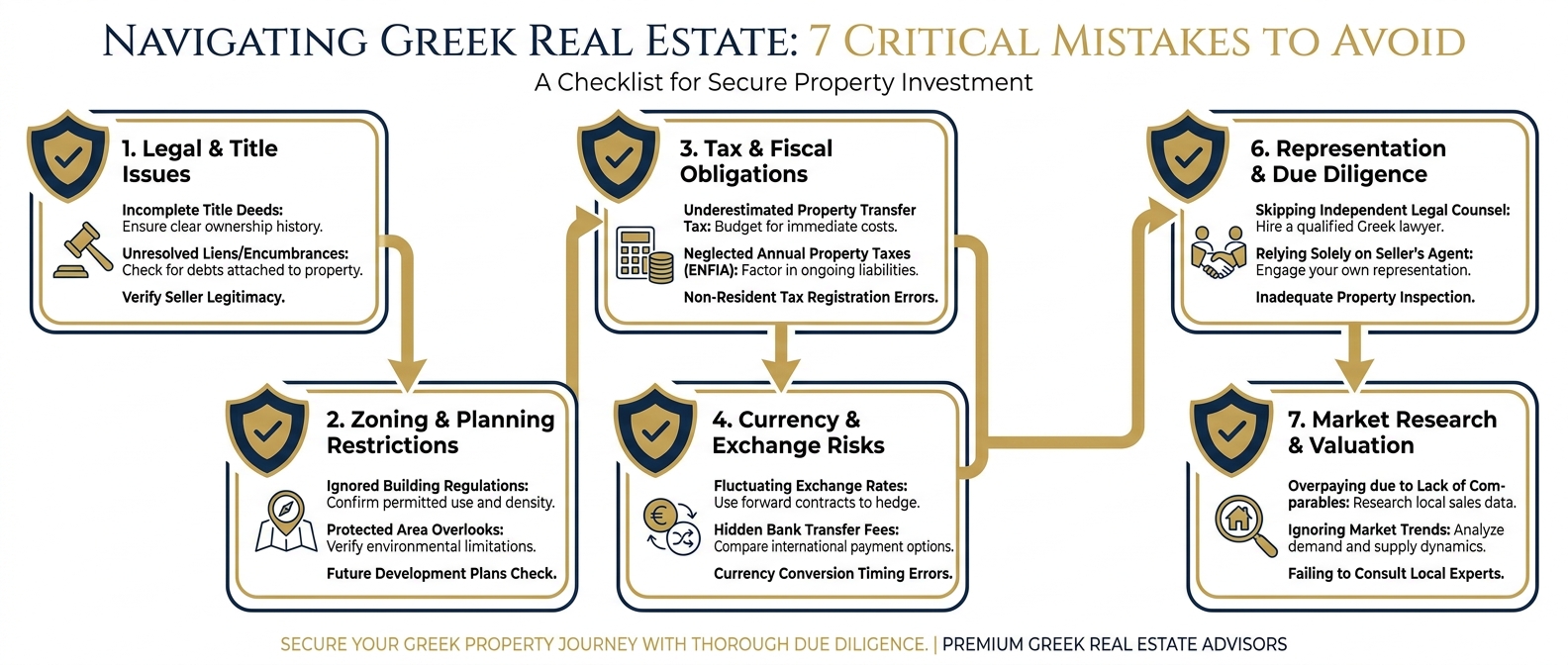
- Never skip independent due diligence: Always hire your own civil engineer to verify structural legality and a lawyer to check all title deeds before signing any preliminary contracts.
- Avoid dual agency conflicts: Relying on the seller’s lawyer or real estate agent leaves you unprotected; you need a dedicated buyer’s agent to negotiate solely on your behalf.
- Verify zoning laws rigorously: Purchasing land or property near forests, coastlines, or archaeological sites without strict checks can result in unbuildable land or unforeseen demolition fines.
- Account for hidden costs and currency shifts: When accounting for ENFIA tax arrears, transfer taxes, and currency exchange fluctuations, additional expenditures may elevate the final acquisition cost by up to 10%
How Skipping Independent Due Diligence Jeopardises Your Investment
Skipping independent legal and technical due diligence is the single most destructive error a foreign buyer can make in Greece. Unlike in many Western countries, a Greek notary public does not verify the structural legality or the historical ownership disputes of a property; they merely authenticate the transaction documents.
Many international buyers assume that if a property is listed for sale, it is legally sound and structurally compliant. This is a serious misconception. In Greece, years of informal building practices have resulted in several properties featuring illegal extensions, unpermitted swimming pools, or enclosed balconies that were never registered with the urban planning office (Poleodomia). If you purchase a property with undeclared illegalities, the financial and legal burden of legalising them—or facing demolition orders—transfers entirely to you.
Furthermore, legal due diligence is paramount. Your independent lawyer must conduct a rigorous search at the local Land Registry (Ypothikofilakeio). They must trace the property’s title back at least 20 years to ensure there are no hidden liens, unresolved inheritance claims, or third-party encumbrances. When clients approach us looking for houses for sale in Greece, our first step is to deploy our network of civil engineers and legal experts to scrutinise every inch of the property and its paperwork before any monetary transfer.
Why Trusting the Seller’s Lawyer is a Critical Conflict of Interest
Trusting the seller’s lawyer or the listing agent to handle your side of the transaction creates a severe conflict of interest that leaves your capital unprotected. The listing agent and the seller’s legal team have a fiduciary duty to secure the highest price and the best terms for the seller, not to protect you from bad investments.
One of the most frequent mistakes when buying Greek property is accepting the “convenience” of using the seller’s recommended legal counsel to save time or money. This often results in rushed contracts, overlooked property flaws, and unfavourable deposit terms. If a dispute arises over a structural defect discovered right before closing, a shared lawyer cannot aggressively defend your right to withdraw or renegotiate the price.
As a foreign investor, you need an impenetrable wall of protection. You require an independent legal representative who answers only to you, ensuring that the preliminary agreement (I idiotiko simfoniko) includes strict exit clauses protecting your deposit if the technical inspection fails. This is why working with a dedicated buyer’s agent in Greece is non-negotiable for serious investors. We ensure that your legal representation is entirely independent, fiercely protective of your interests, and highly experienced in international transactions.
🚀 Expert Insight: The Illusion of the “Standard Contract”
In our experience at Atalos Estate, there is no such thing as a “standard” property contract in Greece. Sellers often present preliminary agreements drafted to trap the buyer’s deposit even if legal issues arise. We always mandate that our clients’ independent lawyers insert specific “subject to legal and technical clearance” clauses, ensuring your funds are 100% refundable if the property fails our rigorous checks.
What to Avoid in Greece Property Zoning: Forests and Coastlines
Ignoring strict Greek zoning regulations regarding forest lands, coastal zones, and archaeological sites can result in purchasing completely unbuildable land. Greek law heavily protects its natural and historical heritage, and building regulations outside of designated city plans (ektos sxediou) are notoriously strict and frequently updated.
If you are looking at Corfu properties for sale or dreaming of a secluded villa in the Peloponnese, you must verify the land’s classification. A plot may look like a perfect building site, but if the local Forestry Department (Dasarxeio) classifies even a fraction of it as protected forest land, you will be legally barred from building. Similarly, coastal properties are subject to strict setback lines (Aigialos), dictating exactly how close to the water you can construct or renovate.
Furthermore, Greece is an archaeological goldmine. If your property falls within a designated archaeological zone, any excavation or renovation requires approval from the local Ephorate of Antiquities. If ruins are discovered during your foundation dig, construction can be halted indefinitely. Before purchasing any land or standalone villa, your engineer must secure a recent, certified topographic plan that explicitly clears the property of forestry, coastal, and archaeological restrictions.

How Overlooking ENFIA Arrears Can Cost You Thousands
Failing to verify that the seller has cleared all ENFIA (Uniform Real Estate Property Tax) arrears and municipal taxes means you could inherit substantial hidden debts. Under Greek law, a property cannot be legally transferred unless the seller provides a tax clearance certificate, but bureaucratic loopholes and delayed updates can sometimes obscure outstanding liabilities.
ENFIA is an annual property tax assessed on all real estate in Greece. If the previous owner has defaulted on these payments, or on local municipal taxes (TAP) and utility bills, these debts can attach to the property itself. ENFIA is a personal liability of the seller, so your lawyer is required to request a 5-year ENFIA certificate, since without it, the transfer cannot take place.
To avoid this, your legal team must demand up-to-date tax clearance certificates before the final deed is signed. Additionally, if you are purchasing an apartment in a shared building, you must verify that the seller owes no outstanding communal maintenance fees (kinoxrista). When our clients invest in apartments for sale in Athens, we conduct a thorough audit of the building’s management records to ensure our buyers do not inherit years of unpaid elevator maintenance or central heating bills.
Comparison: Common Buyer Mistakes vs. The Atalos Protected Process
| Aspect of Purchase | Common Foreign Buyer Mistake | The Atalos Estate Protected Process |
|---|---|---|
| Property Sourcing | Relying on public portals with outdated, overpriced listings. | Accessing off-market properties and negotiating local market rates. |
| Legal Representation | Using the seller’s recommended lawyer (conflict of interest). | Appointing independent, vetted, English-speaking property lawyers. |
| Technical Checks | Trusting the seller’s engineer that the property is “legal”. | Deploying our own civil engineers for rigorous structural and zoning audits. |
| Financial Transfer | Sending funds directly through high-street banks with poor FX rates. | Utilising specialised FX brokers to save thousands on currency exchange. |
| Renovation | Underestimating costs and trusting unverified local contractors. | Providing end-to-end project management with trusted, licensed builders. |
Why Mismanaging Currency Exchange Timing Destroys Budgets
Mismanaging the timing of your currency exchange and relying on traditional banks for international transfers can inflate your property purchase price by up to 10%. Foreign buyers from the US, UK, and non-Eurozone countries often overlook the volatility of exchange rates and the exorbitant hidden fees charged by high-street banks.
When you purchase high-value real estate, such as Greece Golden Visa properties, a minor fluctuation in the USD/EUR or GBP/EUR exchange rate can mean a difference of tens of thousands of euros. Many buyers wait until the day before the final contract signing to transfer their funds. If the exchange rate has moved unfavourably in the months since the preliminary agreement was signed, the buyer is forced to absorb a massive, unexpected cost.
To mitigate this risk, sophisticated investors use specialised foreign exchange (FX) brokers rather than traditional banks. FX brokers offer forward contracts, allowing you to lock in a favourable exchange rate f often up to a year or more. This guarantees exactly how much your property will cost in your home currency, protecting your investment from market volatility.
🚀 Expert Insight: Securing Your Golden Visa Funds
For our non-EU clients pursuing the Greek Golden Visa, the exact origin and transfer method of funds are heavily scrutinised by Greek authorities. Funds must be transferred from an account in the buyer’s name directly to the seller’s Greek account or a Greek bank account in the buyer’s name. We guide our clients through this strict financial compliance to ensure their visa application is not rejected due to a simple banking error.
The Danger of Underestimating Renovation Costs and Timelines
Underestimating the true cost of renovations and the timeline required for Greek building permits is a trap that frequently exhausts foreign buyers’ budgets. Purchasing a “fixer-upper” in Greece can be highly profitable, but the bureaucratic hurdles and supply chain realities differ from those in the US or Northern Europe.
Many foreign buyers assume they can quickly remodel a kitchen or add a bathroom within a few weeks. However, in Greece, even minor internal alterations often require an “Approval of Small-Scale Works” (Egkrisi Ergasion Mikris Klimakas) from the local urban planning office. If you are undertaking major structural work, securing a full building permit can take a few months. Furthermore, if you are purchasing commercial real estate, such as Greek hotels for sale, the renovation must comply with the Greek Ministry of Tourism Registration Number (MHTE): standards to operate legally.
Material costs on the islands are also significantly higher than on the mainland due to shipping and logistics. A renovation budget for a villa in the Cyclades will look vastly different from a similar project in Athens. Before committing to a property that requires work, you must have an independent engineer provide a detailed, itemised renovation quote and a realistic timeline that accounts for Greek public holidays and during August, as most construction activity slows down
Navigating the Market Without a Dedicated Buyer’s Agent
Attempting to navigate the opaque and fragmented Greek real estate market without a dedicated buyer’s agent leaves you vulnerable to inflated “foreigner pricing” and substandard properties. In Greece, there is no central Multiple Listing Service (MLS), meaning property data, historical sale prices, and market trends are not publicly accessible.
When foreign buyers search online, they often view properties that have been sitting on the market for years, usually priced above their actual market value. Listing agents represent the seller, and their primary goal is to maximise the seller’s profit. Without local representation, you have no leverage to negotiate the true market value, nor do you have access to the lucrative off-market properties that are sold privately before ever reaching the internet.
This is where Atalos Estate changes the game. As an exclusive buyer’s agency, we do not list properties; we hunt for them based on your exact criteria. Whether you are seeking high-yield Athens Riviera apartments or a secluded island retreat, we leverage our local network to find the best assets, conduct ruthless due diligence, and negotiate aggressively on your behalf. We protect your interests from the initial search through to the final handover of the keys.
Submit a Property Request today, and let our expert team secure your ideal Greek investment safely and efficiently.
🚀 Expert Insight: The Power of Off-Market Access
Our team at Atalos Estate secures properties that are not publicly listed. Sellers of high-end Greek real estate often prefer discretion and only share their properties with trusted buyer’s agents. By partnering with us, you bypass the saturated public market and gain exclusive access to Greece’s hidden real estate gems.

If you are ready to invest in Greece without the stress, delays, and financial risks, you need a team that stands exclusively in your corner. Contact Our Team at Atalos Estate to schedule your initial consultation and discover how we make buying property in Greece a secure, seamless, and highly rewarding experience.
FAQ — Frequently Asked Questions
What are the biggest Greece property buying mistakes foreigners make?
The most significant mistake is skipping independent legal and technical due diligence. Foreign buyers often trust the seller’s agent or lawyer, leading to conflicts of interest and the inheritance of illegal property extensions or hidden debts. Always hire an independent buyer’s agent, lawyer, and civil engineer to protect your investment.
Do I need my own lawyer when buying property in Greece?
Yes, hiring your own independent lawyer is absolutely essential when buying Greek real estate. A notary only authenticates the transaction; they do not protect your interests or check for deep-rooted legal issues. Your lawyer will investigate the Land Registry for liens, debts, and ensure the title deeds are completely clean.
What should I know about Greek property zoning laws?
Greek zoning laws are incredibly strict, especially concerning coastal zones, forestry land, and archaeological sites. Purchasing land outside the city plan (ektos sxediou) requires rigorous checks by a civil engineer to ensure it is legally buildable. Failing to verify these zones can result in buying land where construction is permanently prohibited.
How do currency exchange rates affect my property purchase in Greece?
Currency fluctuations can drastically alter the final price of your property if you are buying with USD, GBP, or other non-Euro currencies. Relying on traditional banks for the transfer often results in poor exchange rates and high hidden fees. Using a specialised foreign exchange broker allows you to lock in rates and save thousands on the transaction.
Why should I use a buyer’s agent in Greece?
A buyer’s agent works exclusively for you, the purchaser, ensuring you do not overpay due to inflated “foreigner pricing.” Because Greece lacks a central MLS, a buyer’s agent provides access to off-market properties and historical pricing data. They also coordinate the entire legal and technical due diligence process, safeguarding your capital from start to finish.